
Published design subscription prices run from under $1,000 to about $5,000 a month. Here we compare the three we could verify on the vendor's own page, what each includes, and where a $3,995 plan sits among them. Each one sounds like the same promise, send as many requests as you like for one flat fee, so we also translate each plan's limit into designer time.
Planning your first subscription and have not set up the basics yet? The launch checklist on the start here page covers what to have in place before the first payment. This page is about the number on the offer.
Design subscription prices, side by side
Every figure below comes from the vendor's own pricing page. We list the plan each page showed us. For ManyPixels that is the Advanced plan, which may not be its cheapest tier, so do not read it as the entry price.
| Offer | Price per month | Active requests or equivalent | Stated turnaround | Users | What the vendor says is included | Implied price per stated hour |
|---|---|---|---|---|---|---|
| ManyPixels Advanced | $699 billed monthly, or $559 a month billed yearly | 1 daily output | Next-day delivery | Not stated on the plan | Unlimited requests, revisions and brands; project manager; choose your designer; Slack channel | Hours not stated, so not derived |
| Penji Essentials | $995 | 2 active workstreams, "Equal to 2-4 hrs daily" | 1 day turnaround | Not stated on the plan | Branding and logos, ad creatives and social media, email and newsletters, print and packaging, Canva templates, project manager | About $12 to $24 (arithmetic below) |
| DesignJoy Monthly Club | $4,995, shown as a "Lifetime Discount - Limited Time" off $5,995 | One request at a time | Average 48-hour delivery | Up to 2 | Unlimited brands, Webflow development, unlimited stock photos, pause or cancel anytime, 75% back within 7 days | Hours not stated, so not derived |
Penji is the only one of the three that puts hours on its limit. Its page says the two workstreams are "Equal to 2-4 hrs daily" but does not say how many days count. Assume 21 working days a month as an illustration: that is 42 to 84 hours. $995 divided by 84 hours is about $11.85 an hour; $995 divided by 42 hours is about $23.69. That is the range in the table. If Penji counts calendar days, the hourly figure drops further. We have not invented hours for ManyPixels or DesignJoy, because neither page states any.
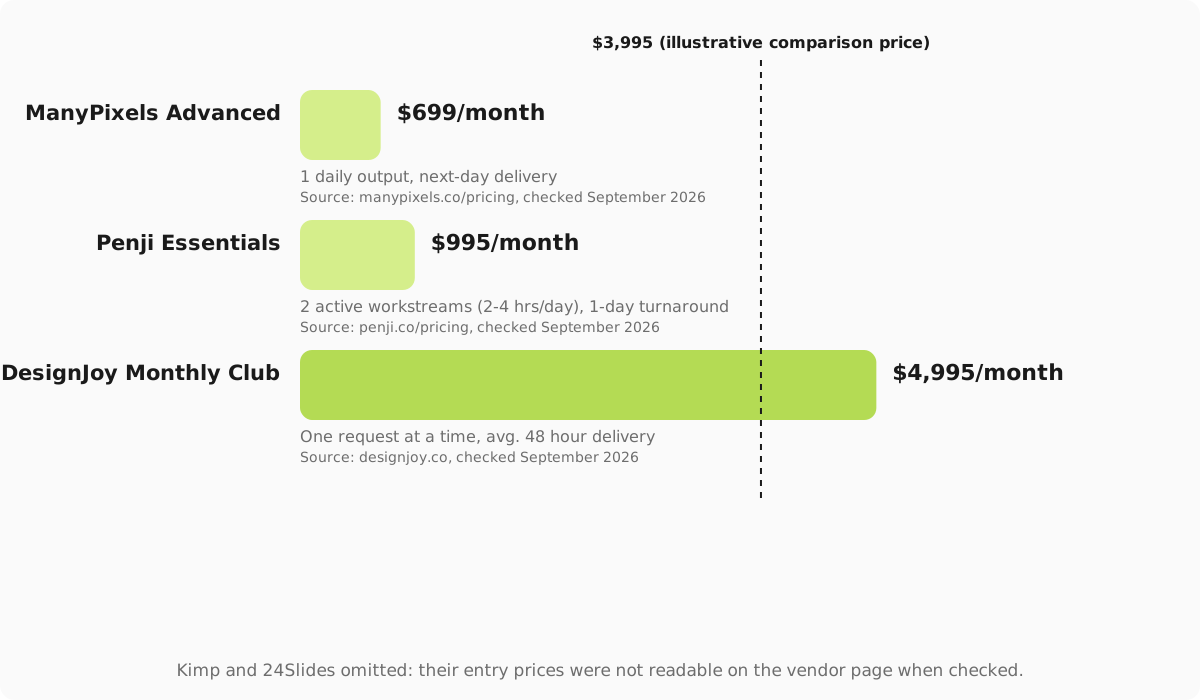
Two well-known names are missing on purpose. Kimp and 24Slides both sell design subscriptions, but when we checked in September 2026, their prices were not readable on their own pages. So we do not quote figures you may have seen elsewhere.
What "one request", "two workstreams" and "one daily output" mean
All three offers say unlimited. None of them mean unlimited at once. Each one meters the work differently, and the meter is where the real product is.
- One request at a time (DesignJoy)
- The client can queue as much as they like, but only one item is in production. DesignJoy states an average 48-hour delivery, so a client who keeps the queue full gets roughly one finished piece every two working days. Brett Williams, who runs DesignJoy, described the same rhythm in his March 2022 Indie Hackers post. "I deliver a reasonable size of work every 2 days and keep moving at that pace," he wrote. The page does not say how big one request can be. That definition is yours to write, and the one active request rule walks through a real week of it.
- Two active workstreams (Penji)
- Two items in production at once, and Penji puts a number on it: "Equal to 2-4 hrs daily". This is the only plan of the three that tells the buyer how much designer time the fee buys.
- One daily output (ManyPixels)
- A cap on finished pieces rather than items in progress: one output a day, with next-day delivery. The pricing page does not define how large one output can be, so ask before you compare it with a request-based plan.
Here is what that means on a Tuesday morning for a client with five things waiting. On DesignJoy, one of the five is being worked on. On Penji, two are. On ManyPixels, one comes back each day. The fees differ by a factor of seven, and the queue looks almost the same.
Why DesignJoy costs several times more
At $4,995, DesignJoy Monthly Club costs five times Penji Essentials ($995) and just over seven times ManyPixels Advanced ($699). Both of those prices were also. The queue rule is no more generous. The difference is in what the page says you get alongside it.
- Webflow development is included. Neither of the other two plans lists website builds, so a client who needs a landing page designed and built pays one fee instead of two.
- A small roster. The page says the studio "focuses on delivering top-notch quality to a limited roster of clients at a time". It does not give a number.
- A named senior designer. The volume offers run teams. ManyPixels co-founder Robin Vander Heyden wrote in a lessons-learned post on Indie Hackers that 20 designers relied solely on ManyPixels for their income. DesignJoy sells one person's work.
- A refund that lowers the risk of the first month. "75% back, no questions asked" within 7 days.
The strongest clue is in Brett's own words. In the same March 2022 post he wrote that he "decided to double my prices because there was no way I could manage a waitlist". The price is set by how scarce one person's time is, not by hours delivered. A June 2025 podcast recap listed "Fixed pricing: $5,000/month"; the homepage now shows $4,995 against a $5,995 list price. Read the $5,995 as an anchor and $4,995 as the price you are competing with.
What solo design subscription founders say
Founders rarely publish their numbers. These are the ones we could trace to the founder's own words, with the date each was written.
- May 2021. In an Indie Hackers AMA, Brett Williams reported "30+ clients" at "$50-60k in monthly recurring revenue", with one active request per client. He said he completed "12-13 requests per day" and worked "roughly 50-60 hours per week" while also holding a full-time job.
- March 2022. The same founder: "My solo shop just surpassed the $1.5M milestone", bringing in "roughly $4,500 a day right now", after doubling his prices.
- April 2022. ManyPixels co-founder Quentin Gilon wrote that "It took us a bit more than three years to pass the $100K MRR mark" in his marketing plan post.
- Undated. His co-founder Robin Vander Heyden, in the lessons-learned post quoted above, gave $45-$55k MRR with three full-time employees plus the 20 designers.
Know the limits before you use any of this. The founder posts are four and five years old; the plan prices in the table are from September 2026. The AMA author never stated a price per client, and commenters' guesses are not evidence, so we do not divide revenue by client count to invent one. What the posts do show is the shape of the work: one person shipped 12 or 13 requests a day at 50 to 60 hours a week. That is a ceiling someone hit, not a plan to copy.
Where a $3,995 design subscription should sit
$3,995 a month sits $1,000 below DesignJoy and about four times Penji Essentials. At Penji's implied $12 to $24 an hour, $3,995 would buy roughly 170 to 340 hours of stated Penji time. A client who compares on hours will never choose you. So the price has to buy something the volume offers do not sell. Before you publish it, write these into the offer page:
- Name who does the work. If it is you, a senior designer with a portfolio the client can see, say so on the page.
- State a turnaround and hold it. DesignJoy says an average of 48 hours. If yours is slower at $1,000 less, explain what the client gets for the wait.
- List what is included that the $699 and $995 plans leave out, such as a website build, strategy calls or brand direction.
- Define one request in writing, with three examples of what fits and one of what does not.
- Work out how many clients you can carry before you sell the first slot, using the capacity and profitability guide.
If you already charge £2,500 to £4,000 a month, convert before you compare. The xe.com currency converter gave a mid-market rate of 1 USD = 0.7547 GBP, checked 23 September 2026. At that rate, £2,500 is about $3,310 and £4,000 is about $5,300. Your top tier already sits above DesignJoy's $4,995. The question for a higher tier is not whether the market allows it but what that client gets that the £2,500 client does not.
The method for setting your own number, from hours to margin, lives in the service design and pricing guide. Put your figures into the pricing and capacity worksheet and test them against a busy month, not an easy one.
What design subscription studios do not publish
None of these operators publish churn, retention or average client tenure. The closest figure is Quentin Gilon's note that "around 35% of our customers come from referrals", which tells you how ManyPixels finds clients, not how long they stay. ManyPixels prices a yearly commitment at $559 a month against $699 monthly, but the page does not say how many clients take it.
Track your own retention from the first client: start date, pauses, cancellation date and the reason given. After six months you will know more about your retention than any public source can tell you, and the billing and retention guide shows where to record it.